01. RNN Examples
Recurrent Neural Networks
So far, we've been looking at convolutional neural networks and models that allows us to analyze the spatial information in a given input image. CNN's excel in tasks that rely on finding spatial and visible patterns in training data.
In this and the next couple lessons, we'll be reviewing RNN's or recurrent neural networks. These networks give us a way to incorporate memory into our neural networks, and will be critical in analyzing sequential data. RNN's are most often associated with text processing and text generation because of the way sentences are structured as a sequence of words!
RNN's and Text Generation
At the end of this lesson, you will be tasked with creating a TV script generator; a model that takes in a series of words as input and outputs a likely next word, forming a text, one word at a time.
Similarly, RNN's can be used to generate text given any other data. For example, you can give an RNN a feature vector from an image, and use it to generate a descriptive caption. Image captions are used to create accessible content and in a number of cases where one may want to read about the contents of an image.
Sketch RNN
One of my favorite use cases for RNN's is in generating drawings. Sketch RNN (demo here) is a program that learns to complete a drawing, once you give it something (a line or circle, etc.) to start!
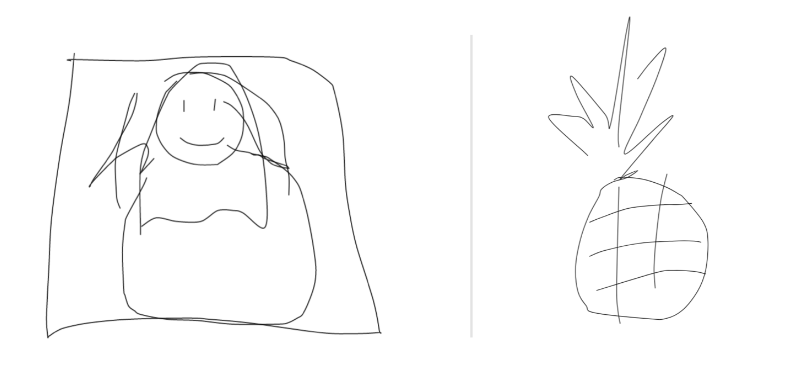
Sketch RNN example output. Left, Mona Lisa. Right, pineapple.
It's interesting to think of drawing as a sequential act, but it is! This network takes a starting line or squiggle and then, having trained on a number of types of sketches, does its best to complete the drawing based on your input squiggle.
Next, you'll learn all about how RNN's are structured and how they can be trained! This section is taught by Ortal, who has a PhD in Computer Engineering and has been a professor and researcher in the fields of applied cryptography and embedded systems.